
Campfire Ban in Effect for North Saanich
Effective 12 p.m. (noon) on Thursday, July 16, Category 1 campfires are now prohibited in North Saanich under the BC Wildfire Service’s Coastal Fire Centre restrictions. Category 2 and Category 3 open fires remain prohibited. The prohibition is expected to remain in effect until October 31, 2026, unless rescinded earlier.
Our community is situated in an environmentally diverse region with rich natural resources and features. The District, and specifically the Fire Services department, strives to protect our residents and their surroundings by reducing the inherent wildfire risk that exists in our community.
Here's a brief summary of the efforts made by the District in recent years, including some specific information on efforts relating to LAU,WELNEW/John Dean Provincial Park, an area of specific concern for many of our residents.
- 2011: The District's first Community Wildfire Protection Plan (CWPP) was prepared, funded by a successful grant application. A CWPP assists local governments in identifying wildfire risks in their community, as well as opportunities to reduce those risks.
- 2018: North Saanich purchased informational wildfire prevention signage, banners, and booklets to increase resident awareness, and also prepared a mailout to residents containing key strategies to reduce wildfire risk on their property.
- 2018-2019: The District has completed over 50 FireSmart home and property assessments over the past two years. A majority of these assessments were located in the Dean Park neighbourhood. For information on property assessments, please contact the North Saanich Fire Department.
- 2019: North Saanich hosted an open house at Panorama Recreation on May 4, which is Wildfire Community Preparedness Day.
- 2021: After a process of community engagement, the District prepared a revised CWPP, again funded by a successful grant application. This CWPP provides the District with a framework that can be used to review and assess areas of identified high fire risk. The CWPP also helps guide the improvement and/or development of emergency plans, emergency response, evacuation plans, communication and education programs, relevant bylaw development, and the management of potentially hazardous nearby forest lands.
In addition to efforts made by the District, BC Parks has been continually working to address wildfire risk in LAU,WELNEW/John Dean Provincial Park, including conducting several detailed wildfire threat assessments, and performing work to remove vegetation that increases wildfire risk, such as brush and small/downed trees. As of 2019, BC Parks has banned smoking in all provincial parks year round (except for within camping areas), and they have further plans in motion to reduce wildfire risk in the park, which are expected to commence in 2020.
For information on what you can do to reduce wildfire risk to your home and community, please refer to the BC FireSmart Manual.
If you have any questions regarding wildfire prevention efforts in the District, please contact the North Saanich Fire Department.
FireSmart is a methodology of managing wildfire risk in our community. It is a proactive prevention program, which empowers individuals to share the responsibility of wildfire risk reduction with government and industry partners.
We all have the ability to reduce the risk to our homes, neighbours, and community through FireSmart.
Head to the FireSmart BC website for toolkits, guides, and other great resources.
www.FireSmartBC.ca
Request a Property Assessment in North Saanich
FireSmart Begins at Home
Reduce the potential impacts of wildfire on your home
View the interactive guide on how wildfires grow and spread: begins-at-home-guide.firesmartbc.ca
Will It Burn?
Increase the wildfire resiliency of your property!
Read about fire-resistant plants, landscaping best practices, and special plant tags to look for at firesmartbc.ca/landscaping-hub
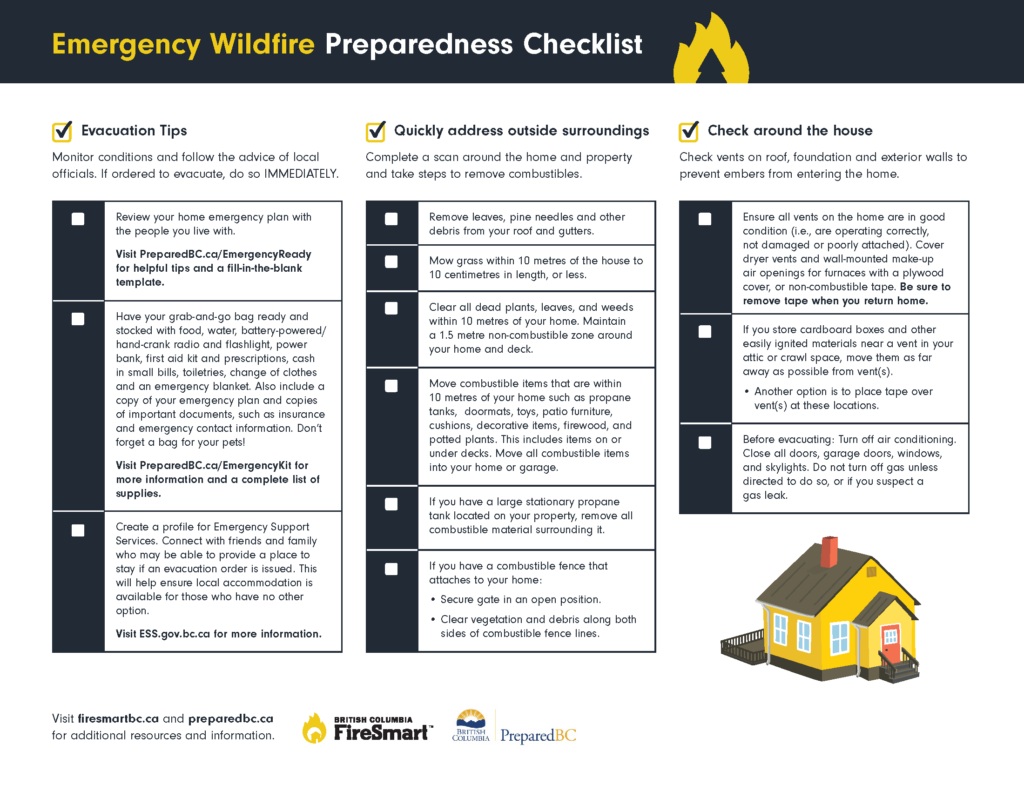
Emergency Wildfire Preparedness Checklist
Download and print out the attached PDF to ensure you’ll be ready in case of an emergency.
What is the FireSmart Wildfire Mitigation Program?
The FireSmart BC Wildfire Mitigation Program (WMP) was designed to engage residents in voluntary wildfire mitigation activities by offering a professional home assessment with property-specific recommendations.
What is a FireSmart BC Wildfire Mitigation Property Assessment?
A FireSmart BC Wildfire Mitigation Property Assessment provides residents with:
- An in-depth, on-site assessment conducted by experienced fire professionals.
- An opportunity for property owners to identify mitigation actions unique to their property.
- A detailed follow-up report with customized mitigation actions designed to measurably reduce the wildfire risk to your property.
- An opportunity to earn FireSmart acknowledgement for your mitigation achievements through a certificate. The certificate is given upon successful completion of required mitigation actions and an on-site follow-up inspection.
- A mitigation certification that can be shared with participating insurance providers to showcase mitigation activities and may be eligible for insurance incentives or discounts. Please note: FireSmart does not share the assessment or any details of the assessment with the insurance industry.
FireSmart Home signage for their property (upon successful completion of required mitigation actions and an on-site follow-up inspection).
Ember the FireSmart Fox
Meet Ember, FireSmart’s official mascot. Ember teaches Canadians how to apply FireSmart principles to their homes and properties so they can be more resilient against the threat of wildfire.
Post-Fire Case Study for The 2023 Grouse Complex, BC 2023
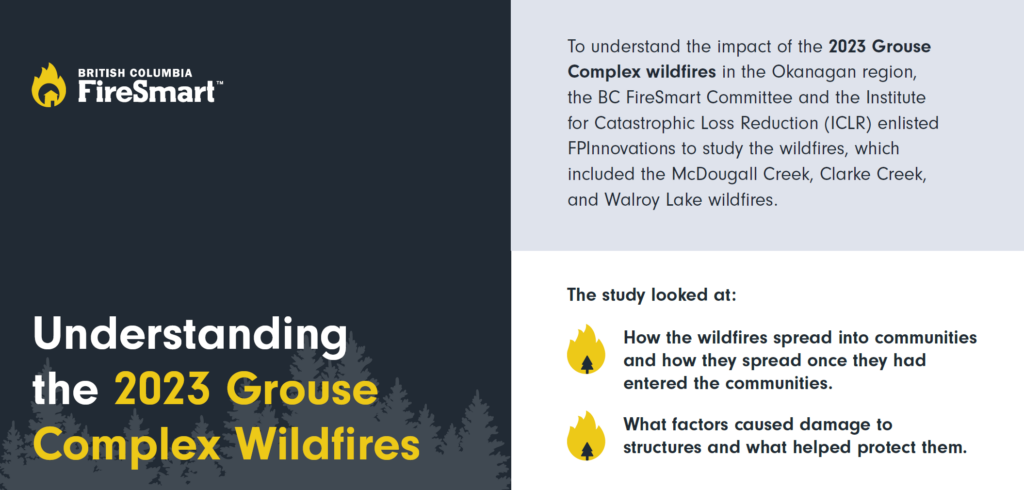
Download the Grouse Complex Wildfires Poster
In August 2023, the Grouse Complex of wildfires in the Okanagan region burned a total of 15,076 hectares, prompting the evacuation of about 30,700 people from 12,100 properties and affecting 303 structures.
To understand the impact of these fires, the BC FireSmart Committee and the Institute for Catastrophic Loss Reduction (ICLR) enlisted FPInnovations to analyze the Grouse Complex wildfires, which included the McDougall Creek, Clarke Creek, and Walroy Lake wildfires.
The study focused on:
- How the wildfire spread into communities and how it continued to move once there.
- Factors that caused or prevented damage to buildings.
The results provide practical recommendations to help governments, wildland and structural fire agencies, insurers, community leaders, residents and decision-makers in reducing wildfire risk in the future.